.png)

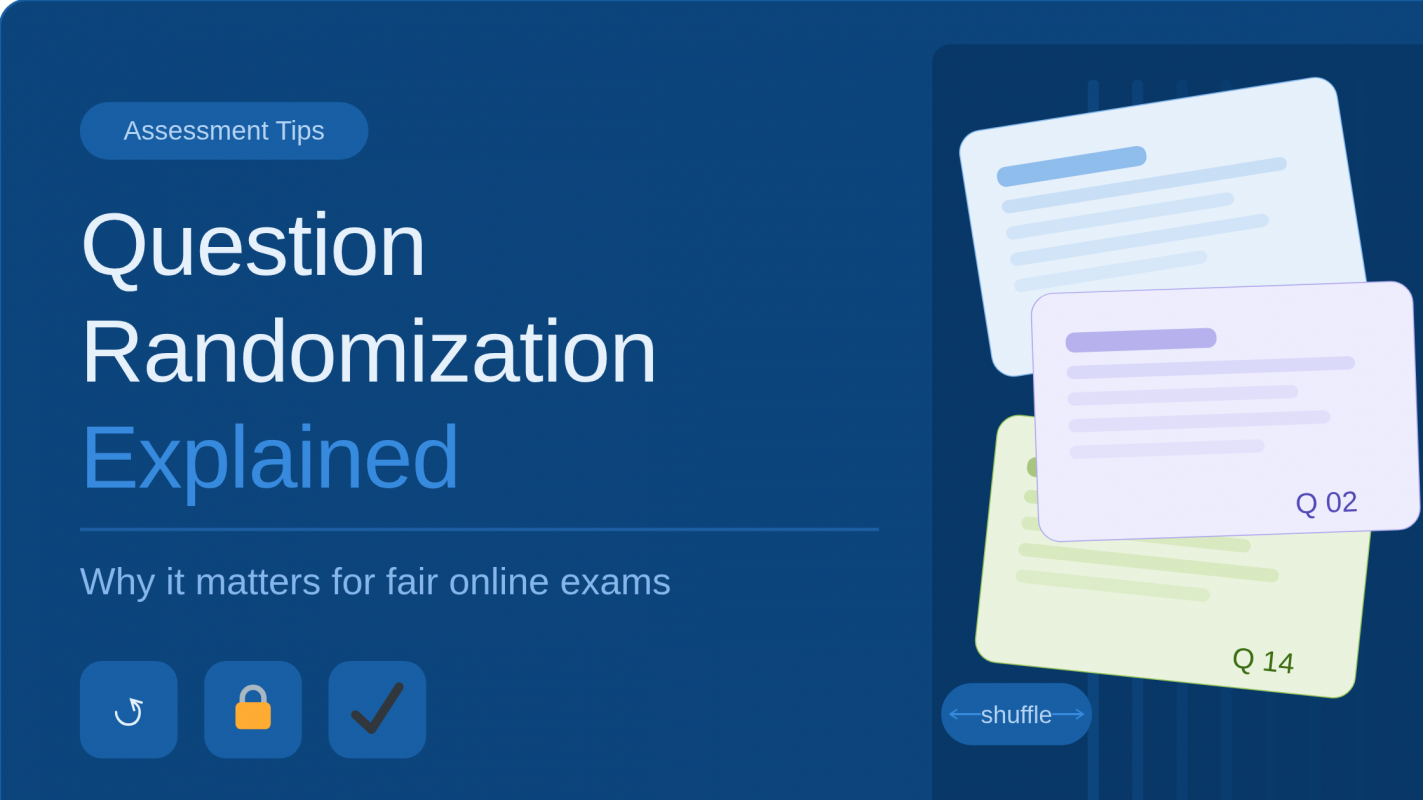
Imagine two students sitting the same online exam side by side. Without question randomization, both see the exact same questions in the exact same order making it easy to copy answers, share responses, or recall patterns from a friend who took the test earlier. Question randomization closes that gap. It's one of the most powerful yet often overlooked features of a modern online assessment platform. Here's everything you need to know about how it works and why it matters.
What is question randomization?
Question randomization is a feature that automatically changes the order of questions and sometimes answer choices every time a learner takes a quiz or exam. Instead of every test-taker seeing Q1, Q2, Q3 in sequence, one student might see Q7, Q2, Q14, while another sees Q3, Q11, Q5. The content is the same; the sequence is unique to each individual.
Most advanced platforms, including Savsoft Quiz, take this further by drawing from a larger question bank for example, pulling 30 questions at random from a pool of 100 so that no two exams are truly identical.
Key distinction: Randomizing question order and randomizing question selection from a bank are two different features and the most secure assessments use both together.
Why question randomization matters
1. It prevents cheating and answer sharing
This is the most immediate benefit. When students see different questions in different orders, it becomes nearly impossible to whisper answers across a room, photograph a screen, or coordinate with someone who took the test minutes earlier. The exam is effectively personalized without extra work from the instructor.
73% - of educators cite answer sharing as their top online exam concern
2× less likely to share answers when question order differs between students
100% unique exams when combining order randomization + question bank selection
2. It ensures every student is assessed equally
In a fixed-order exam, early questions might be easier giving students a confidence boost while harder questions appear at the end when fatigue sets in. This can skew scores based on question placement, not knowledge. Randomization removes positional bias, so every student's result reflects actual understanding rather than where the hard questions happened to fall.
3. It reduces the value of leaked exam papers
A common risk in institutional exams is that previous batches share question papers with incoming students. When you randomize from a large bank, even if someone gets hold of an old paper, they can't rely on seeing those exact questions or in that order. The exam stays fresh across multiple batches and semesters.
4. It supports honest retake policies
When a student retakes an assessment, randomization ensures they encounter a genuinely different experience. This makes retakes meaningful not just an exercise in memorizing last time's answers.
Without randomization
Every student sees Q1 → Q2 → Q3 in the same order. Student B can copy from Student A. Second attempt reveals the same questions. Leaked papers are fully exploitable.
With randomization
Each student sees a unique sequence drawn from a question bank. Copying is ineffective. Retakes surface different questions. Leaked papers are largely useless.
Types of randomization to know
Question order randomization
The simplest form — the same set of questions is presented in a different sequence for each student. Easy to set up, immediately effective against answer-sharing.
Answer choice randomization
For multiple-choice questions, the answer options themselves are shuffled. This prevents students from memorizing patterns like "the answer to Q5 is always B" and stops optical coordination during in-room exams.
Question bank selection
Questions are drawn at random from a larger pool. If your bank has 80 questions and each exam uses 25, the probability of two students receiving identical exams drops to near zero. This also allows you to cover the same learning objectives from multiple angles.
Section-based randomization
For longer assessments, randomization can be applied within sections rather than across the entire exam. This preserves logical flow (e.g., all grammar questions together, all math questions together) while still randomizing within each topic area.
Pro tip: When using section-based randomization, ensure your question bank has at least 3–4 times more questions per section than the number drawn. This gives the algorithm enough variety to keep each exam genuinely unique.
How to set up randomization effectively
- Build a question bank with significantly more questions than each exam will use at minimum a 3:1 ratio (3 bank questions per 1 exam question).
- Tag questions by topic, difficulty, and learning objective so that randomization still delivers a balanced exam.
- Enable answer choice shuffling for all multiple-choice questions, not just questions overall.
- Use section-level randomization for structured exams where topic flow matters.
- Test the randomization before publishing by previewing the exam multiple times to confirm different sequences appear.
- Review analytics post-exam to check for any questions that performed unusually — position effects can surface even with randomization if question phrasing varies too widely in difficulty.
Common concerns answered
"Won't randomization make the exam harder for some students?"
Not if your question bank is well-calibrated. Tag questions by difficulty level and configure the platform to draw an equal proportion of easy, medium, and hard questions for every student. The exam feels different in sequence but equivalent in challenge.
"Does it affect scoring or grading?"
No. Scores are calculated based on correct answers, not question position. The marking system works identically regardless of what order a student saw the questions.
"Is it compatible with timed exams?"
Yes. Randomization and time limits work independently. The timer starts when the student begins the exam, regardless of which questions are served first.
Conclusion
Question randomization is not just a technical checkbox it's a foundational element of fair, secure, and credible assessment. Whether you're running university entrance exams, employee certification tests, or routine training quizzes, randomization ensures that every learner's result is a genuine reflection of their knowledge.
The good news: you don't need to do any of this manually. Savsoft Quiz handles question randomization, answer shuffling, and bank-based selection automatically so you can focus on writing great questions rather than worrying about exam integrity.





Comments
Loading comments...